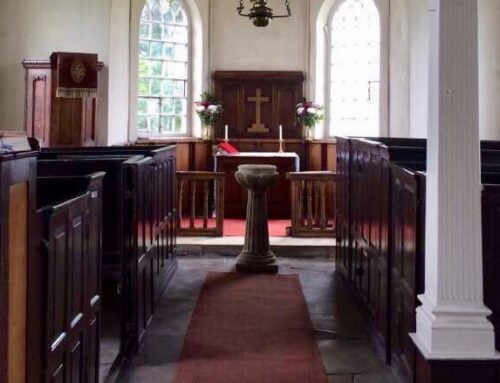
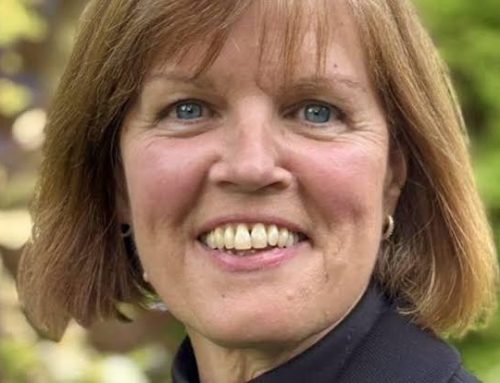
The Rt Revd Glyn Webster preaching at the Solemn Mass at Holy Trinity Church, Tarleton on The Fast of the Most Blessed and Holy Trinity , May 31st 20206 said, “If you think you understand the Trinity, then you dont Understand the Trinity”, but he went on to say we dont need to worry about understanding it just accept it in love and faith.
Preaching on the Feast of Title of the Church in the 140th year of the Laying of the Church’s Foundation stone Bishop Glyn said:
If you fully understand the Trinity, then you don’t understand the Trinity. Instead you have made a God who fits entirely into a small human brain; a God created by you; not the God who created us.
Today’s Gospel ends with a commission to the eleven disciples to go and make other disciples baptizing them in the name of the Father and of the Son and of the Holy Spirit.
But let’s not start at the end but at the beginning; at the mountain Jesus told them to go to. We don’t know which mountain that was but it’s important to note that it was a mountain. Why? Well because this is a theophany; that is a manifestation of God; a moment when God reveals themself. In this case it is God in the form of the resurrected Jesus appearing to his disciples and speaking to them.
Throughout the Bible, theophanies, moments when God appears to mortals, occur on mountain tops. Mountain tops which are thresholds of mystery; places where heaven meets earth. Moses among all the prophets experienced the most theophanies. From the burning bush at Mount Horeb to the giving of the Law at Mount Sinai in fire, smoke, and lightening. Moses ascended Sinai at least seven times to enter the divine glory and hear God’s voice.
In today’s Gospel Jesus is both the new Moses and the theophany. Trinity Sunday is really the crowning of the church’s year but is more infamous for being the preacher’s nightmare. In Advent we waited for the birth of the Saviour; at Christmas we saw God made manifest in the birth of the Christ Child; in Lent we journeyed to the cross knowing it is the instrument of our redemption. The Easter season sees death defeated in the resurrection of Christ. Last week – at Pentecost – the advocate and comforter – the Holy Spirit was outpoured. And now – in this theophany – we see the source of it all: Father, Son, and Holy Spirit.
In the resurrected Jesus the eleven disciples see the theophany of the New Covenant: go and make other disciples baptizing them in the name of the Father and of the Son and of the Holy Spirit.
The Trinity is not simply a doctrine but an idea that seeks to explain – albeit most imperfectly – the life and being of God and it is through baptism that we are incorporated – made members – of that divine life.
And the only response to this theophany is that of the disciples: they worshipped.
Let all mortal flesh keep silence
And with fear and trembling stand …
Veil their faces to the presence,
As with ceaseless voice they cry,
Alleluya, alleluya, Alleuya, Lord Most High!
Worship is the only response to a divine revelation for it exposes the huge chasm between the infinity of God and our tiny finite lives. It is little wonder that ‘some of the disciples doubted’. This is not disbelief but more like hesitation. But it’s a reminder that faith is rarely flawless and doubt-free. These disciples are looking directly at the resurrected Lord, but some still wavered.
And yet Jesus commissions the whole group – waverers and all – to baptise in the name of theHoly Trinity. The disciples aren’t left atop that mountain in holy fear but adopted as God’s children through Baptism.
Every Eucharist we begin with the sign of the cross in the one name of the Father, Son, and Holy Spirit.
We do this as a reminder of our baptism and we offer our praise of thanksgiving to the Father, through the Son, in the power of the Spirit.
And in every Eucharist the God who revealed his divine nature to those eleven disciples on that mountain top comes to us as he promised:
“Behold, I am with you always, even to the end of the age.” The God who came to earth as a tiny vulnerable child comes to us in the forms of bread andwine.
St Augustine wrote: “If you see charity [sacrificial love], you see the Trinity. The Father is the Lover,the Son is the Beloved, and the Holy Spirit is the Love that binds them.”
Trinity Sunday reminds us that there is no point in trying to fathom the mystery which is the Trinity but rather to see that it is a mystery that we enter into “by the door of the Sacraments” (St Augustine).
Where love binds us the lover and the beloved. It is a call not to be explain a doctrine but to share in the Divine life and to call others to share in that threefold name of the Father, the Son, and the Holy Spirit.