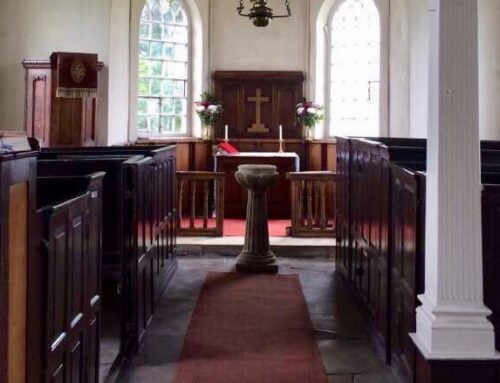
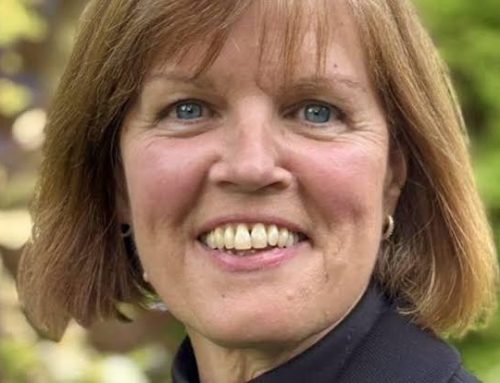
Speaking at the 10am Mass at Holy Trinity Church, Tarleton on the Feast of the Transfiguration and the 80th Anniversary of the dropping of the Hiroshima Nuclear Bomb (August 6th 2025) Fr Joe posed this challenge: “So today, as the world remembers a light that destroyed, and the Church remembers a light that transfigures, let us be people of the second light.”
The Address in full:
If there’s one thing our world isn’t short of, it’s noise. Whether it’s the endless scroll of social media, the 24-hour news cycle, the pressure to have opinions on everything, or just the busyness of life – there are voices coming at us from all sides. Everyone seems to be saying: “Listen to me.”
And then we come to this moment on the mountain. Jesus takes Peter, James, and John to pray. And while he’s praying, something extraordinary happens: his face changes, his clothes shine like lightning, and suddenly Moses and Elijah, representing the Law and the prophets, are there with him. It was overwhelming for the 3 disciples…
But then comes the most important moment. A cloud descends – just as it did in the days of Moses – and from the cloud, a voice speaks:
“This is my Son, my Chosen; listen to him.”
It’s not a suggestion. It’s a command. There in the middle of all the glory and all the awe, God draws the disciples’ attention not to the light or the cloud, but to the voice of Jesus.
Peter, does what many of us do when we’re overwhelmed – he talks. “Let’s build three tents!” he says, trying to capture the moment, to make sense of it, to do something. But Luke gently adds, “He did not know what he was saying.”
There’s a time to speak and a time to be silent. The mountain is not a place for Peter’s plans—it’s a place to listen.
Now, here’s where the lectionary and the calendar intersect in a striking way.
Today, 6 August, the Church celebrates the Transfiguration. But in the world’s memory, this day is also remembered for something else: the dropping of the first atomic bomb on Hiroshima in 1945 – 80 years ago to the day. A single flash of light – a brilliance and destruction unlike anything the world had seen – ushered in a new and terrible era.
The stories of these two “dazzling moments” could not be more different. Both involved a sudden burst of light, both changed the world – but their meanings could not be further apart.

One was a flash of human power, born in a world at war, filled with complexity and fear. It reminds us of the awe and burden of human achievement – how easily brilliance can be harnessed in service of destruction.
The other was a revelation of divine glory – not to terrify or destroy, but to reveal, to bless, to prepare for what lay ahead. The light of Hiroshima fell from the sky and levelled a city. The light of Christ shone from within him, pointing to the cross and to the glory of resurrection beyond it.
So today, I’m not going to open a debate or make any moral judgements about decisions that were made 80 years ago in the fog of war. But we do pause to ask:
What kind of light are we following? In what kind of glory do we trust?
Daniel’s vision gives us one answer. He sees the Ancient of Days seated on his throne. He sees “one like a Son of Man” coming in glory, to whom is given dominion and kingship. This is the true King – not the kings of violence or empire, but the King whose glory is eternal.
And in our second reading, Peter, looking back on the Transfiguration, urges the Church to pay attention to what he and the other witnesses saw and heard on the mountain that day.
“You will do well to be attentive to this – as to a lamp shining in a dark place.”
In a world that still trembles with conflict, greed, and fear, we’re not called to chase every new flash or listen to every loud voice. We’re called to listen to him. To let the steady light of Christ guide us through the dark.
For us, that means making space in our lives for his voice. We make space by spending time in prayer, with Scripture, in stillness. It means letting his words shape us more than the news, more than our anxieties, more than our pride.
It means remembering that the glory Jesus shows us is the glory of the cross. The glory of mercy. The glory of self-giving love.
The Father doesn’t command us merely to look at Jesus, or admire him, or even adore him – though we are certainly called to do all of those things. On the mountain, his command is more direct, more personal: “Listen to him.” Give to Jesus not only your adoration, but your attention. Not only your wonder, but your obedience.
To listen is to allow his voice to shape our hearts. Christian discipleship begins not with action, but with attentiveness – learning to recognise his voice, to trust his words, and to follow where he leads. The glory revealed on the mountain isn’t meant to stay there; it is meant to draw us into deeper faithfulness on the ground.
So today, as the world remembers a light that destroyed, and the Church remembers a light that transfigures, let us be people of the second light.
Let us listen to him.
Let us follow him.
Let us walk in his light.
Amen.