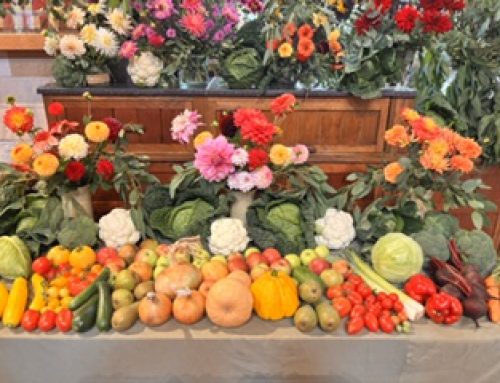
In his sermon at our Ash Wednesday services the Asst Curate prayed: “May this Lent not be filled with empty spiritual calories, but with the grace that feeds, strengthens and restores. “
Fr Joe’s Sermon in full:
Well, it’s good to be home! I very much enjoyed my placement at St. George’s – but it’s great to be back amongst you all – amongst people I know well enough that we can be honest with one another… And so, in the spirit of honesty, I’ll be the first to admit, I could stand to lose a few pounds. I mean, the fact that I’m slightly out of breath climbing the pulpit steps is a testament to that fact.
I know I need to get more exercise, but the doctor has also warned me to keep an eye on the amount of “empty calories” that I eat. Empty calories are calories which come from eating foods with little to no nutritional value.
I don’t have much of a sweet tooth, but things like crisps, crackers, snack foods are my downfall. The problem with empty calories isn’t just that they don’t help you — it’s that they leave you feeling full, while your body is still hungry. They leave you unnourished.
And I was thinking about this as I considered our first reading from the Prophet Isaiah.
In this part of the book, the people of Israel had been complaining that God seemed as though he was not listening to them. They were fasting and praying, but God seemed distant.
But while they were busy fasting and praying, they were also exploiting the poor, they were ignoring the hungry. They humbled themselves before God while trampling others underfoot.
Essentially, their worship had become like eating empty calories… it filled the space, but there was no nourishment in it. It was empty…
And so in our reading this morning, God asks, “Is not this the kind of fasting I have chosen: to loose the chains of injustice, to set the oppressed free? Is it not to share your food with the hungry and to provide the poor with shelter, when you see the naked, to clothe them?”
God has no desire for empty words. True worship is transformative. It transforms our hearts, it nourishes our souls, and is reflected outwards in love for our neighbours. Faith, in other words, is meant to be nourishing. Not just for us, but for others.
True worship feeds. And because it feeds, it changes us.
And that’s why this reading is placed before us at the beginning of Lent.
Lent is not primarily about giving things up. It is about conversion – it’s about the reorientation of our whole life – a turning back to God with all the heart.
And to help us in this, we have what has become the three pillars of lent: prayer, fasting and almsgiving.
These thee spiritual exercises can help us to reshape three relationships that sin distorts: our relationship with God, with ourselves, and with others.
And in our Gospel today, notice the words which Jesus chooses. When he speaks about fasting, prayer, and almsgiving, he doesn’t say IF you do these things… this is how to do it… He says WHEN.
He says: “When you pray… When you fast… When you give alms…”
It highlights just how important these three activities are for of our spiritual lives and they compliment one another. Each is needed. Let’s look at each.
We start with prayer. Prayer restores our relationship with God…
It is the raising of the mind and heart to God. It is not merely words; it is relationship. In prayer we let go of the illusion that we are in control. We remember that we depend on God — that our life is a gift, held in his mercy and love.
During Lent, prayer intensifies because our need becomes clearer. The ashes we receive today remind us that we are dust. And in Genesis, dust only lives when God breathes into it. We cannot animate ourselves. Prayer is how we open ourselves again to that breath.
For some of us, this may mean committing to a steady pattern — five minutes of silence each day, prayerful Bible study, attending Mass more regularly, coming to Holy Hour, or perhaps praying Compline before bed.
Prayer is the anchor of our Lenten discipline. Without prayer, fasting becomes self-discipline. Without prayer, almsgiving becomes philanthropy. Prayer is what roots everything in God.
And then there is fasting… Fasting restores us to ourselves.
It’s said that repentance doesn’t stay hidden; it shows itself in the way we live. Fasting is one of the ways that inner turning becomes visible.
Its aim, though, is not the outward act itself but the freedom it creates within us. It loosens our grip on what we cling to. It teaches us that we are not meant to be ruled by appetite or impulse, but to live with a steadier, freer heart.
We live in a culture of constant consumption. If we feel discomfort, we look to immediately alleviate that discomfort with food, noise, scrolling, distraction. We rarely sit with hunger — physical or spiritual.
Fasting introduces a chosen hunger. And that hunger reveals something. It shows us how easily we are mastered by habit. It shows us how quickly we reach for comfort. It shows us how little space we allow for God.
The fast God desires, Isaiah says, is one that awakens justice and compassion. Hunger that turns our attention outward. Hunger that opens our eyes to those whose deprivation is not chosen – but forced upon them.
When we fast, we learn freedom. We begin to discover that our deepest hunger is not for comfort, but for God.
Without fasting, prayer risks becoming words without conversion. Without fasting, almsgiving can come from surplus rather than sacrifice. Fasting reminds us that love costs something.
And this leads to almsgiving. Almsgiving restores us to our neighbour.
It is not an optional kindness. It is an expression of charity — and charity is the very life of God shared with us.
When we give, we participate in God’s generosity. We loosen the illusion that what we possess belongs solely to us. We recognise that everything is gift.
Isaiah makes it plain: true fasting is inseparable from care for the poor. Jesus tells us how: give quietly, sincerely, without performance.
Almsgiving may mean setting aside money deliberately for the needy. It may mean increasing our giving here at church. It may mean offering time, attention, patience.
Without almsgiving, prayer can become self-enclosed. Without almsgiving, fasting can become self-focused. Charity carries grace outward.
Together, these three practices form a kind of spiritual architecture.
Prayer turns us toward God.
Fasting orders our desires.
Almsgiving directs love toward others.
They are not isolated devotions; they are expressions of conversion.
And we hear St. Paul’s words to us today: “Now is the favourable time.”
Ash Wednesday does not exist to make us feel guilty. It exists to wake us up. To remind us that life is fragile. That time is limited. That grace is being offered now.
In a few moments, we will receive ashes on our foreheads. “Remember that you are dust, and to dust you shall return.”
Those words are humbling. But they are also liberating. If we are dust, then we do not have to pretend to be self-made. If we are dust, then we can stop feeding ourselves on what does not satisfy.
Lent is not about religious busyness. It is about nourishment.
If we make time to allow prayer to become deeper,
if we allow our fasting to make us freer,
if our giving and generosity becomes wider,
then something real will grow.
And perhaps that is the question to carry into these forty days:
- Where is my life undernourished?
- Where has faith become habit rather than hunger?
- Where is God inviting me to turn again?
Now is the favourable time.
May this Lent not be filled with empty spiritual calories, but with the grace that feeds, strengthens and restores. Amen